
Your First Jiu-Jitsu Class in Longmont, Minute by Minute
From the parking lot to the handshake at the end. Written for the person who has been meaning to try this for two years and keeps not going.
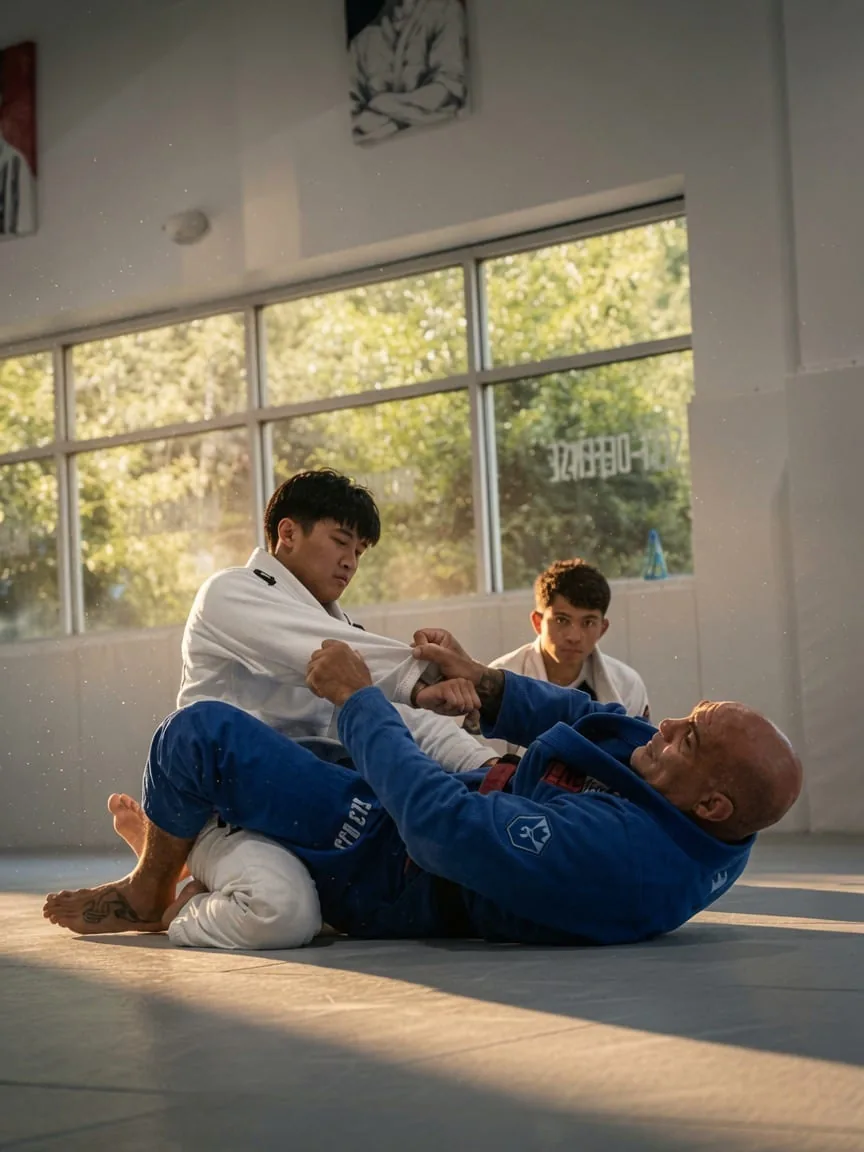
Almost nobody hesitates because they are missing information. They hesitate because of three sentences their brain runs in the parking lot: I am not in shape yet, I will be the worst one there, and everyone will be watching me.
So here is the whole hour, in order, so none of it is a surprise. The unknown is doing more work to keep you in the car than the training ever will.
Before you leave the house
- Wear a t-shirt and shorts or leggings. No zippers and no pockets, because fingers and toes get caught in them.
- Cut your fingernails and toenails. This is the one piece of etiquette people forget and everybody notices.
- Bring water. Bring flip flops if you have them, since nobody walks to the bathroom barefoot.
- Eat something small about two hours before, not twenty minutes before.
You do not need a uniform. You do not need to have watched anything on YouTube. Showing up having studied is not a head start, and occasionally it is the opposite.
The first ten minutes
You park directly outside the door on the I-25 frontage road. Somebody meets you, usually Mike, who is on the mat for every intro class. You sign a waiver, you get shown where to change and where to leave your shoes, and you get told the two rules that matter: shoes never touch the mat, and feet never touch the floor outside it.
Then you step on, and the first thing you will notice is that nobody is looking at you. Everyone in that room was the new person once, most of them recently enough to remember it clearly.
Warm-up, roughly ten minutes
Movement specific to grappling rather than punishment cardio: shrimping down the mat, getting up off the ground without using your hands, some rolling and breakfalls. It is awkward the first time for everybody, including the people who played college sports. You go at the pace you can go at, and that is the expectation, not a concession.
Technique, roughly twenty-five minutes
One or two techniques get shown slowly, broken into steps, then shown again. You pair up with somebody and take turns doing it on each other with no resistance at all. Nobody is trying to beat you during this part. Your partner is almost certainly correcting their own details while you correct yours.
You will do it wrong. Everybody does it wrong. Getting corrected five times in twenty minutes is what the class is for, and it is the clearest sign the room is paying attention to you.
Do you have to roll on the first day?
No. Live rolling is where two people actually go at it, and on your first day you can sit on the side and watch it instead. Plenty of people do, and nobody comments on it.
If you do want to try it, you will be paired with somebody experienced, which is counterintuitive but correct. An experienced partner controls the pace and keeps you safe. The dangerous roll is two beginners with something to prove.
You tap by tapping your partner twice, clearly, on their body or the mat, or by saying tap out loud. You can tap for any reason at all, including that you are tired, your knee feels funny, or you simply want to stop. Nobody asks why. Tapping early for two years is how people get to train for twenty.
The last five minutes, and the next two days
Line up, bow out, shake hands with everybody in the room. That handshake is not ceremony, it is the entire culture of the sport compressed into ten seconds.
You will be sore in places you did not know were places, mostly your neck, your hands and the sides of your ribs. It is worst on day two and it mostly stops happening after the third week.
The part nobody tells you
You will probably drive home replaying the hour, and there is a reasonable chance you will want to come back before the soreness even arrives. That is the normal reaction, and it is why people who try one class tend to still be training a year later.
Your first class here is free, one full hour, no card and no contract. Pick a time. Saturday at 10:00 is the easiest one to start with if you work regular hours.